
One of the most common things I hear during consultations is "I've had laser hair removal before, but it never worked" or "I've been getting laser treatments for years with very little results."
Here is what I have learned after hearing it hundreds of times: in most cases, the problem is not that laser hair removal does not work. It is that the treatments were not performed correctly.
I always ask two questions.
Question 1: What Kind of Laser Was Used?
I cannot tell you how many times the answer reveals that the wrong laser was used for the client's skin tone.
Fair-skinned clients treated with a diode or Nd:YAG when Alexandrite would have produced better results. Darker-skinned clients treated with a diode when Nd:YAG would have been the correct and safer choice.
This happens for a simple reason: a clinic that owns one machine uses that machine on everyone. If the device is not right for your skin type, your results will be mediocre no matter how many sessions you buy.
We use the Candela GentleMax Pro specifically because it houses both Alexandrite (755 nm) and Nd:YAG (1064 nm), so the wavelength is chosen for you rather than for the equipment.
Question 2: What Settings Were Used?
The second answer is usually "I don't know", and that itself is a problem worth knowing about.
Two failure patterns show up here.
Settings that were too low from the start. Low settings feel safe, but they do not deliver enough energy to destroy the follicle. You get temporary shedding and thinning, then everything returns.
Settings that were never increased. This is the bigger one, and it is the reason so many people plateau.
Clients often see great results in the beginning, then progress stops. The reason is almost always that the settings stayed the same while the hair changed.
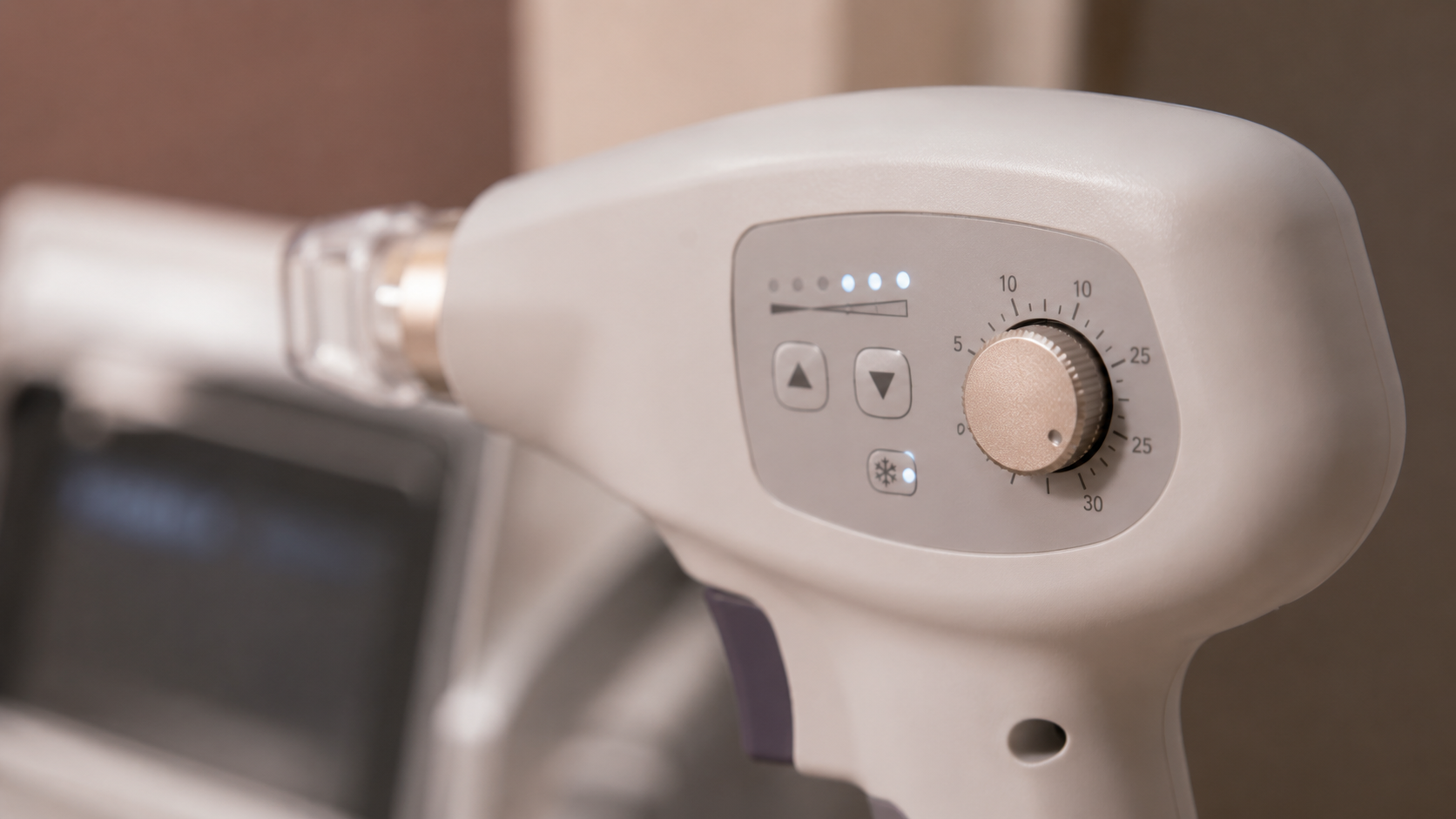
Here is the logic. Thicker, darker hairs absorb more energy, so they require lower settings. As treatments progress and the remaining hairs become thinner and weaker, the laser has a harder time targeting them, so the settings need to go up to keep getting results.
A technician who sets a comfortable level in session one and never revisits it will get you partway there and then stall. If your results were good early and then stopped improving, this is very likely what happened.
And to repeat something clients find reassuring: increasing the setting does not usually make treatment more painful. There is less hair present, so it often feels easier.
"It's Because I'm Hairy" or "It's Because I Have PCOS"
Many people conclude that laser does not work for them because they are especially hairy or because they have PCOS. That is not accurate.
Laser hair removal should work on any dark, pigmented hair when the correct laser and settings are used.
PCOS is a real factor, but it is a different factor than people think. PCOS can cause new hairs to grow over time: it does not stop the laser from destroying the hairs being treated. The hairs we treat are permanently reduced. Your hormones may simply be producing new ones alongside that.
So the practical effect of PCOS, hypothyroidism, or elevated testosterone is that you may need more sessions than average. Not that laser is ineffective for you.
Other Legitimate Reasons Progress Stalls
Hair color. Laser only works on pigmented hair. If a meaningful portion of the hair in the area is white, gray, blonde, or red, laser was never going to remove it, and no amount of sessions will change that. Those hairs need electrolysis. If you have "pepper hair" (a mix of dark and white), the correct approach is to treat the white hairs with electrolysis, then shave and treat the dark hairs with laser.
Waxing or tweezing between sessions. If there is no hair in the follicle, the laser has nothing to target. Those follicles are simply skipped that session.
Spacing sessions too far apart too soon. Extending your interval before your hair growth has actually slowed down can regress progress. Your schedule should follow your hair, not the calendar.
Coming in too soon. The opposite also matters. You want the maximum number of hairs present at each session. Waiting the recommended interval gives more hairs a chance to enter the growth phase where the laser can reach them.
Not finishing the course, or skipping maintenance. Most people need 6–8 sessions initially, followed by maintenance. If touch-ups are skipped completely, regression and returning hairs are expected, not surprising.
What a Proper Plan Looks Like
For reference, a typical schedule runs:
- First 3 sessions: every 4 weeks
- Next 1–2 sessions: every 6 weeks
- Final 1–2 sessions: every 8 weeks
Then maintenance: 1–2 sessions every 6 months, then 1–2 every year, then once every 2–3 years.
Facial hair that grows much faster and thicker than average is the one exception where I may start clients at every 2 weeks before moving to the standard 4-week schedule.
Throughout all of it, settings should be climbing as your hair thins.
Getting a Second Opinion
If you have done laser elsewhere without results, come in and let us look at it. We will identify what wavelength is appropriate for your skin tone, assess what hair is actually present and whether it is pigmented enough for laser to work, and build a settings progression rather than a fixed number.
Sometimes the honest answer is that laser is the wrong tool for your hair color and electrolysis is what you actually need. It is better to hear that now than after another twelve sessions.
Related reading
- Laser Hair Removal for Dark Skin: Why the Right Laser Changes Everything
- Hair Removal With PCOS, Thyroid Issues, and Hormonal Imbalance
- How Many Laser Hair Removal Sessions Do You Actually Need?
Have a question this didn't answer? Book a free consultation at our Midwood, Brooklyn studio or call 718-360-2902. We'll look at your hair and skin, answer everything, and build a plan with you.